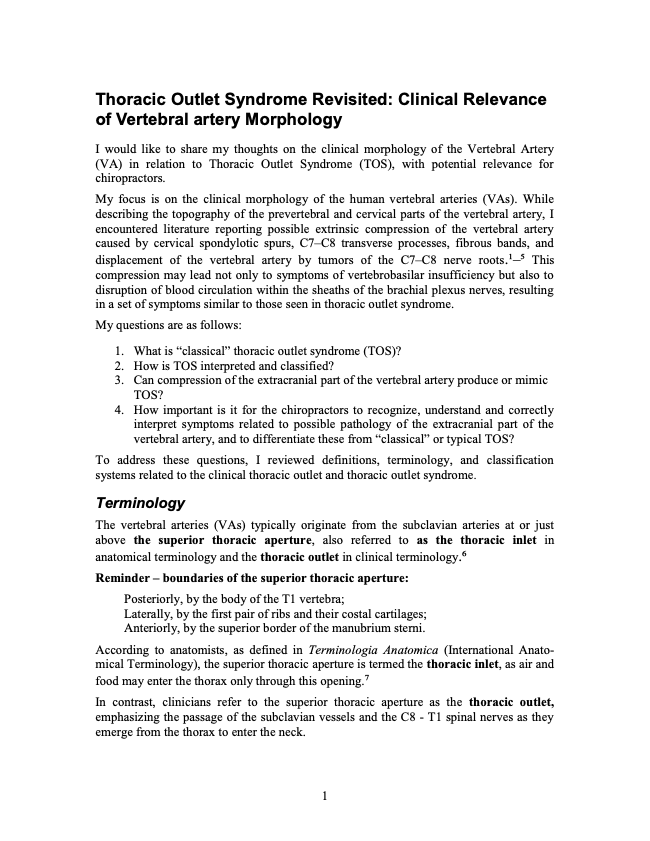
“I would like to share my thoughts on the clinical morphology of the Vertebral Artery (VA) in relation to Thoracic Outlet Syndrome (TOS), with potential relevance for chiropractors.”
From the opening of the article
In the article
Terminology1
Sites of Compression2
What is Thoracic Outlet Syndrome?2
Classification & Etiology3
Conclusion5
References5–6
The original manuscript, page 1 of 6.
The author’s original document, with its references and formatting preserved.
Academic profile
Anatomy, education & clinical relevance
Myroslava Kumka, MD, PhD, is an anatomy professor and researcher. Her work explores the structures and variations of the human body, with particular attention to their relevance in clinical practice.
Her research interests include musculoskeletal and neurovascular variation, the classification of fascia, and the innervation of vertebral arteries.
She joined Canadian Memorial Chiropractic College (CMCC) in the fall of 2000. Her roles there included Associate Professor and Anatomy Department Chair; she served as Chair from 2008 to 2020. Her teaching encompassed clinical gross anatomy, neuroanatomy, embryology, histology and histopathology, as well as continuing education.
A variant extensor indicis muscle and the branching pattern of the deep radial nerve could explain hand functionality and clinical symptoms in the living patient
Myroslava Kumka
The Journal of the Canadian Chiropractic Association. March 2015;59(1):64–71.